Friday, May 23, 2025

From Costa Cálida to Costa del Sol


Frigiliana


Cartagena

The drive along the coastal regions was scenic in many areas but the last stretch was through a mountainous area where we found our chosen campsite to be too secluded from grocery stores and too difficult to reach the city. So we headed right back through the mountains to Area Autocaravanas Cartagena. 


Our photos here


We were happy with our choice which put us in a suburb with stores, restaurants and public transportation in easy walking distance and only cost €15 per night. Cartagena is jam-packed with historical sites. We visited the museum preserving the defensive walls built by the Cartheginians, the impressive Roman theater, and the port as well as several ruins we just happened on.


 Cartegena is known for having graceful architecture in the Modernista style - heavily influenced by Gaudi. The façades of these lovely buildings have graceful balconies and are nearly dripping with twining plant and flower motifs as well as colorful ceramics. 


The Roman Forum far exceeded our expectations both in the size and quality of the conservation as well as the explanations in English. Their baths were incredible - they featured every temperature from a cold plunge pool to a sauna and spaces to socialize. We remarked it would have been far better than the gym we pay for monthly and they were free to the public.


Many times we noted the apartments that overlooked these incredible sites. Can you imagine having a Roman theater or forum as your everyday view?!


We capped the day off by heading to a tapas bar set in an entire block of restaurants flanked by a plaza which included a playground where children played while their parents relaxed at tables.  Our camp host had explained that this area was dominated by and made for locals so the prices were typical (not tourist prices). Dermot chose a dish that translated to breaded chicken burger with fries and was disappointed by the pink color and decided lack of chicken taste. I chose the house’s signature salad partially because it included “bocas de mar” which translates to “mouths of the sea” and curiosity got the better of me. It was fairly tasty but nearly drowned in Russian dressing. By process elimination, I determined that bocas de mar was surimi. Their version is made of a very thin layer of a white substance that’s pink on one side. It’s rolled and sliced into logs and tasted slightly of crab, or so I imagined. Your guess is as good as mine as to what inspired the name. When the check came, the server put down a plate which held two shots of Irish Cream and said “for you” with a big smile. We were blown away by this thoughtful gesture. For context, the bill for a bottle of beer and one of cider plus two meals was only €18.80. They knew we were tourists and unlikely to come again and there had been no mention of Irish background. Tourists are not always welcome visitors but we felt welcome here. Not a squirt gun in sight.


Nerja and Frigiliana

The drive to Nerja included some pretty seaside cities but then changed to literally miles and miles of greenhouses covered with white plastic. They must grow an immense amount of produce there!


We returned to Camping Cortijo San Miguel (where we stayed in 2019) and enjoyed its beautiful landscaping but not the fluctuating shower temperature. 
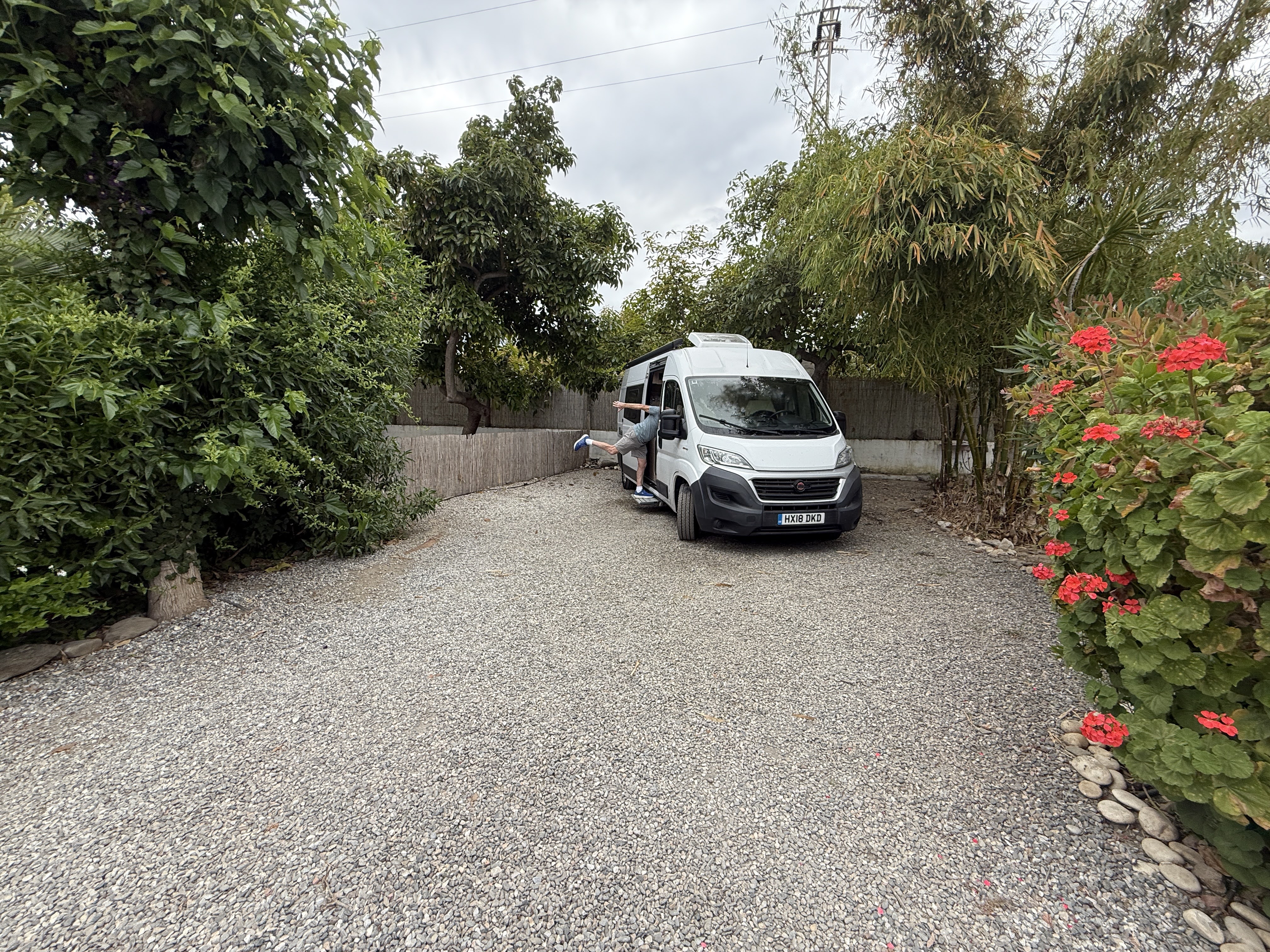


Though there was a sand beach in walking distance we biked into town for dinner. Actually, we biked only until hitting the town where we chose walking with bikes along crowded sidewalks over biking on the roads for the most part because I didn’t trust my biking skills and prefer to live. 


We ate at a Cuban restaurant where Dermot got Ropa Vieja which was made with beef, included crispy cassava, some salad and was very tasty. 


We were surprised it was made with beef rather than pork but learned the dish originated in Spain and the meat used varies regionally. I got a salmon, tomato and avocado salad which was good but also surprised me by the lack of other salad-type ingredients. The owner had a big smile for all his customers and sang Cuban songs as he whizzed through the dining room. On our way home we stopped to soak in the ocean views and the ethereal way the sea and sky melded into each other.


Excited to enjoy another Rick Steves guided walk, we biked into town and boarded the packed bus to the hill town of Frigiliana he described as:


“The picturesque whitewashed village of Frigiliana (free-hee-lee-AH-nah), only four miles inland from Nerja, makes for a wonderful side trip. A thousand feet above sea level, full of history, and feeling like it dropped in from the mountains of Morocco, it’s a striking contrast to its beach resort sister.”


— Rick Steves Spain by Rick Steves

https://a.co/7oyndya


We got a map and bus timetable from the TI but were disappointed the museum was closed and we couldn’t get the handout that described the history explained on the tiles inset on buildings around the town. Despite this and google maps we spent a surprising amount of time lost here. 


“The street plan dates to medieval times, when the Moors tucked their village here, high in the hills away from coastal raiders. The whitewash dates to the 18th century, when a plague killed 40 percent of the population. To sterilize the town, everything was burned or slathered in lime to kill the germs. It turned out that the whitewash reflected the sun, keeping things cool. People liked it, and it remains to this day. While houses must be white, the trim is your choice. Enjoy the traffic-free tranquility, small restaurants, big views, and flowers.”


— Rick Steves Spain by Rick Steves

https://a.co/c198LKi


We enjoyed climbing up and through the various levels that seemed to have grown organically rather than being engineered.  There were impressive views at every turn and the moorish influences are still visible in “hand of Fatima” door knockers and the architecture of arches and door shapes. One street used to be the market street “little souk” and was now lined with pots filled with succulents and flowers. Both our lunch and break spots provided beautiful views and shade which was very much appreciated on this hot day. Dermot noticed the tourists here were mostly British and Irish.


Next stop: Andalusian Hill towns


Tuesday, May 20, 2025

From Costa Daurada to Costa Blanca

Valencia Amphitheater


Tarragona

Driving from Girona to Tarragona signs on the highway tell us in  English "Flat tire? Don't trust strangers." Another warned us to beware of fake accidents. We consider ourselves forewarned. 


Our photos here


Arrival at Camping Las Palmas in Tarragona is a pleasant surprise - sunny, warm weather; two restaurants and huge. We get a spot with  an ocean view, just one space away from the beach for just over $25 per night. Dermot enjoyed watching the El Classico, Barcelona vs Reál Madrid game, which was being aired on a big screen in a courtyard with plenty of space for the many enthusiastic Barcelona fans. Meanwhile, I spend over an hour on a Whatsapp Mother's day call with my "kids." The camp’s restaurant caps the day off perfectly with a bass dinner for two as we gaze at the waves.


All the museum and archeological sites are closed on Monday so we planned to just visit the Cathedral Tarragona and roam around a bit. The Cathedral was so much better than expected since it also contained an art museum and an excellent series of excavated glimpses into the deep past including ancient Roman foundations, walls and a well; medieval additions and a pretty cloister.  This was a real standout cathedral! The art was very enjoyable as there were many exceptional pieces. I got a kick out of a depiction of baby Jesus being a handful and clearly annoying Mary. Another baby Jesus had blond hair, a homely face but an inexplicably jacked physique.


Our choice of Mom and Pop place for lunch reminded us never to go where prices aren’t posted since “tourist rates” will be applied. We strolled the old town including the Jewish quarter then headed for a glimpse of the Roman sites. Turns out, this city has often preserved sections of its ancient Roman past and sometimes built on top of it through Visigoth and Medieval times. We got great views from the outside of many historical sites then made the mistake of taking a tourist train which drove us all over but provided no commentary. 


The following day we visited the Amphitheatre, Roman Circus, Provincial Forum Praetorium, and the walls. For anyone who enjoys history, there’s nothing like being surrounded by it in a place like this with so many layers and interesting elements. Multiple audiovisual presentations attempted to give you the perspective of just how big and grand the Roman city of Tarraco was by showing overlays with present landscapes. We were really impressed.


We ate a delicious lunch at an Indian restaurant. Touristing is thirsty work so in the late afternoon we found a tiny cafe nearly bursting with locals and enjoyed their special of two drinks and tapas for 11 euros. It’s often hard to find parking for our campervan but here we got safe parking in a lot just outside the city walls for only €1 for the whole day. Shocking!


Valencia

Valencia Camper Park is conveniently located five minutes walks from the metro but lacks charm - it’s just gravel with bushes and small trees that dropped some fruits that were crushed into the gravel. We couldn’t avoid tracking this sticky mess into the van. The normal men’s restrooms were under construction so Dermot suffered through some cold showers and times the waiting line was too long.


We spent the first night here researching the public transportation system, what we really wanted to see and how to see it. Once again we wished Rick Steves covered this area. We concentrated on the old town the first day. The trip via metro is a straight shot in but took nearly an hour. 


We first hit the massive Mercado which hosts many vendors in an art deco style building. It’s always fun to visit these busy markets bursting with all manner of fresh produce, meats, and seafood. We choose our lunch from among the prepared salads - mine was a potato, seafood, olive and veggie with a pesto dressing, Dermot’s was tuna, beans, purple onions and veggies with olive oil - both were tasty. Our guide book recommended trying horchata which is a traditional drink in Valencia, made with “tiger nuts.” My own research found these aren’t actually nuts but the edible tubers of a locally grown sedge. There are ground and mixed with water, sugar, and cinnamon. Our guide book told us the best place to get it and a fartón (which is an iced donut in a baton shape) for dunking in the horchata.  We found a bench seat in the market square to enjoy our picnic. The horchata was rich and creamy but too sweet which explained why they also offered one without sugar.


The Set Espai d’Art in the plaza adjoining the Cathedral is the place to get handmade art as well as souvenirs.


The Cathedral’s audio guide was very well done and explained the vast history, archeological findings below ground level, reliquaries, treasure and the art. One of Goya’s paintings is here - complete with demons and blood spraying from a cross. It also boasts the true holy grail - according to their research.


Finnegan’s Irish pub gave us just the rest we needed. We wandered across the Puente de la Trinidad and took in the view of the Jardin del Turia.  We only later learned there’s a whole archeological site below that we missed. The nearby Torres de Serranos was an impressive sight to behold. As we approached our chosen dinner spot, we were both intimidated by how upscale it looked. We’d arrived much earlier than Spaniards like to eat so we were given a table without having made a reservation. We both relished our meals of fish and veggies.


The following day we headed for the extensive modern architecture of the arts and sciences center. We took a tour of the 15 story Les Arts building which was built to resemble a Spartan helmet and clad in a mosaic of ceramic tiles in white and blue. I lost count of the performance spaces housed within it - each with acoustics designed to fit the type of performance - from opera, concerts, plays, and student productions. The seats were designed to ensure the acoustics would be the same no matter how many people attended. Each seat back in the largest space (primarily for opera) included a small screen on which a person could select to view subtitles in their preferred language. Genius!


There are multiple other impressive modern buildings nearby including a science center, IMAX cinema, aquarium, exhibition space, and the most lovely parking garage all flanked by a park. 


Dénia

Feeling the need for a bit of relaxation, we picked Camping Los Pinos, Las Rotes with its location close to the sea but outside of the city and much more comfortable facilities. This city is on the Costa Blanca - known for its fantastic year round weather and beaches. Dermot read that about half the population is from France, Italy, Britain. 


The paved board walk along the rocky beach made for nice walks with beautiful scenery but we never even made it in to see the castle in the heart of the city. Instead we did laundry and yoga at our campsite; ate meals from our tiny fridge and planned our next stop.


Saturday, May 10, 2025

From Bristol to the Catalan Coast


The first travel day is a bear. The straight flight to London, then the long slough to Bristol via train and the wait for our hotel room to be ready. We took turns strolling Bristol, soaking in the picturesque river and dipping into the Cathedral. After one night in a hotel room, we first boarded the wrong train due to a cancellation and then had to navigate a cascade of ripple effect route changes to make it to the right place. Picking up the campervan was seamless then straight to the Cheddar market to pick up a few essentials and finally to Cheddar Bridge campsite where we could finally relax.


Click for photo album, “i” for descriptions


Britains of all ages show their deep appreciation for the rare treat of a sunny warm day in many ways. They drape themselves on benches with books, spread out on grassy lawns, and gather with friends on restaurant patios. Campgrounds are filled with people stretched out, faces raised to bask in the glorious sun. They’ve had several sunny days in a row now so a good number sport sunburns.


Bristol

Thinking the night would be warm, we didn’t turn on the campervan’s heat before turning in and both had a cold, sleepless night not wanting to disturb the other, whom we assumed was sleeping soundly. So much for conquering jet lag! 


The next U.K. direct to Santander, Spain ferry was several days away. A camp employee told us about a friend whose camper alarm had triggered on the overnight ferry to Santander draining the battery so it had to be towed off the ferry and was impounded for a month before it could be fitted with a new battery. We opted to take the shorter Dover to Calais ferry and drive thru France. Spain would have a few more days to recover from the power failure they had suffered which caused chaos. It also meant to we had to pick a new entry point to Spain so we chose Girona.


On our second night in Cheddar we opted for a Greek restaurant and I chose the vegetarian “bifteka.” It was mashed potatoes mixed with a few peas, kernels of corn and flecks of carrots, fried into patties and served over, you guessed it, french fries. A generous estimate would be four grams of protein. 


The drive to Black Horse Farm campsite in Folkestone went smoothly. We used the WiFi at the local pub to reserve a ferry for the following day. The couch up front gave us a view of the sparkling waters, but a good deal of my time was spent trying to find a campsite for the night. In and around Paris was fully booked. While Dermot drove, I got my Airalo eSIM to work (finally) and continued the search. Calls weren’t working so we just headed for a campsite that was off the beaten track and crossed our fingers. 


The drive through the country was so pretty. Rolling hills of patchwork farmland were bright yellow and every shade of green from chartreuse to deep olive. We feared we’d end up in a parking lot but leafy Camping Le Bois des pêcheurs outside the village of Poix-de-Picardi rescued us and we happily ate a cold dinner cobbled together from our supermarket finds from earlier in the day.  That night I made reservations for the next night stay in Camping d’Olivet outside Orleans. 


You’d think a mere three hour drive would leave plenty of time to pop into Orleans and do some sight seeing before heading to the campsite but this isn’t our first European adventure so we headed to the campsite first. Roadwork detours took us down roads ranging from poor to extremely bad necessitating walking pace speed. The forecast called for thunderstorms so we chose to spend the night making do with campsite pizza and salad and move on the next day.


It’s shoulder season so many campgrounds aren’t open yet. Finding a place about four hours driving away further restricted our choices. "Cosy Camp" was open but on arrival it was more dirty than cosy. We found the nearby Camping le Galier and spent one soggy night there after carefully selecting the site we hoped was least likely to flood or require a tow out of. We’d have stayed another day here to hike if the weather had cooperated.


General Observations of Spain:


People are friendly here in Catalonia where both Catalan and Spanish are the co-official languages. We noticed many also speak French. There are a lot of French tourists and locals usually greet us in French assuming we’re the same. I’m pretty sure the French would be mortified. Driving here is a bit more chaotic than in France and things look a bit rougher around the edges.


You really know you’re in Spain when the grocery stores have a literal wall of pernils - hams. These aren’t your garden variety ham, they have raised the curing process to an art form and the prices reflect it. At one grocery store the counter that displayed them was brightly lit and so sharply appointed it almost looked like a jewelry case.


Cadaques

Driving through the Aveyron region was mountainous and lovely. Our email to a campsite in the Cadaqués went unanswered so we just took a chance. The last stretch was through a narrow, winding mountainous road with beautiful vistas steeply down to valleys or the sea. Then our van dashboard started flashing a red oil can along with a wrench and we suddenly realized we hadn’t seen any exits. We drove straight to a gas station that thankfully had oil and we added a quart but that didn’t fix it. 


We arrived at weCamp in Cadaques and were extremely happy they had space. The next morning we took a stroll under cloudy skies around the town which has a nice beach area, a casino and interesting history. We had a delicious lunch and then prepared for our tour of Salvador and Gala Dali’s house and gardens which the campsite staff had arranged. I’m so glad we visited but it would take forever to describe all the surreal details and photos can’t convey the experience. I loved the gardens with the many outdoor “rooms.” The penis-shaped pool and must have been the place for parties. 


The interior rooms were also full of oddities in nearly every corner of the house. When Gala, his love, model and muse died, Dali left the house never to return leaving two unfinished paintings on their easels.


Figueres

We were too nervous about the van’s warning lights to hazard going further out to Far del Cap de Creus so we headed inland and scheduled service on the van. That night while at Camping Esponella, we were told an oil change had been completed before we left and our contact figured the garage had just forgotten to reset the service indicator on it. Reassured, we toured the Dali Theatre-Museum in Figueres instead. 


If you’re a fan of his work, this is like surrealist heaven. Dali was fully involved in the design of the entire museum for decades. His crypt is even here. We really enjoyed it. In most museums, people often have looks of concentration, deep thought, or appreciation. Here, many wandered with smiles lighting up their faces. I believe Dali would be delighted with that legacy.


Girona

This area checks so many boxes: prehistoric archeological sites, roman architecture, Arab Baths and an old town with defensive walls you can actually walk on. We were lucky to arrive on the day before their annual festival of flowers. The city was literally being festooned with blossoms and artistic displays. We often happened onto workers installing sculptures and a wide variety of potted grasses, loose greenery and flowers all throughout the city. 

Our Lonely Planet guide walk took us to many points of interest that, unfortunately, were closed - probably for preparation. We had a wonderful lunch in the old town and when the rain really started in earnest, we popped into the Museu d’Archeologia de Catalunya which is housed in the Monestir de Sant Pere de Galligants which we can’t recommend because of the lack of English descriptions and non-working apps.


The following day we were excited to go to the Parc Neolithic de la Draga which was one of the many prehistoric sites we’d learned about at the museum and very close near our campground but it was also closed so we just took a photo through the fence.


Next: Heading west.


Paris Revisited

This leg of the trip is nerve racking. The big picture is that we need to put the campervan in storage in Bristol then fly from London to Sh...