Saturday, May 10, 2025

From Bristol to the Catalan Coast


The first travel day is a bear. The straight flight to London, then the long slough to Bristol via train and the wait for our hotel room to be ready. We took turns strolling Bristol, soaking in the picturesque river and dipping into the Cathedral. After one night in a hotel room, we first boarded the wrong train due to a cancellation and then had to navigate a cascade of ripple effect route changes to make it to the right place. Picking up the campervan was seamless then straight to the Cheddar market to pick up a few essentials and finally to Cheddar Bridge campsite where we could finally relax.


Click for photo album, “i” for descriptions


Britains of all ages show their deep appreciation for the rare treat of a sunny warm day in many ways. They drape themselves on benches with books, spread out on grassy lawns, and gather with friends on restaurant patios. Campgrounds are filled with people stretched out, faces raised to bask in the glorious sun. They’ve had several sunny days in a row now so a good number sport sunburns.


Bristol

Thinking the night would be warm, we didn’t turn on the campervan’s heat before turning in and both had a cold, sleepless night not wanting to disturb the other, whom we assumed was sleeping soundly. So much for conquering jet lag! 


The next U.K. direct to Santander, Spain ferry was several days away. A camp employee told us about a friend whose camper alarm had triggered on the overnight ferry to Santander draining the battery so it had to be towed off the ferry and was impounded for a month before it could be fitted with a new battery. We opted to take the shorter Dover to Calais ferry and drive thru France. Spain would have a few more days to recover from the power failure they had suffered which caused chaos. It also meant to we had to pick a new entry point to Spain so we chose Girona.


On our second night in Cheddar we opted for a Greek restaurant and I chose the vegetarian “bifteka.” It was mashed potatoes mixed with a few peas, kernels of corn and flecks of carrots, fried into patties and served over, you guessed it, french fries. A generous estimate would be four grams of protein. 


The drive to Black Horse Farm campsite in Folkestone went smoothly. We used the WiFi at the local pub to reserve a ferry for the following day. The couch up front gave us a view of the sparkling waters, but a good deal of my time was spent trying to find a campsite for the night. In and around Paris was fully booked. While Dermot drove, I got my Airalo eSIM to work (finally) and continued the search. Calls weren’t working so we just headed for a campsite that was off the beaten track and crossed our fingers. 


The drive through the country was so pretty. Rolling hills of patchwork farmland were bright yellow and every shade of green from chartreuse to deep olive. We feared we’d end up in a parking lot but leafy Camping Le Bois des pêcheurs outside the village of Poix-de-Picardi rescued us and we happily ate a cold dinner cobbled together from our supermarket finds from earlier in the day.  That night I made reservations for the next night stay in Camping d’Olivet outside Orleans. 


You’d think a mere three hour drive would leave plenty of time to pop into Orleans and do some sight seeing before heading to the campsite but this isn’t our first European adventure so we headed to the campsite first. Roadwork detours took us down roads ranging from poor to extremely bad necessitating walking pace speed. The forecast called for thunderstorms so we chose to spend the night making do with campsite pizza and salad and move on the next day.


It’s shoulder season so many campgrounds aren’t open yet. Finding a place about four hours driving away further restricted our choices. "Cosy Camp" was open but on arrival it was more dirty than cosy. We found the nearby Camping le Galier and spent one soggy night there after carefully selecting the site we hoped was least likely to flood or require a tow out of. We’d have stayed another day here to hike if the weather had cooperated.


General Observations of Spain:


People are friendly here in Catalonia where both Catalan and Spanish are the co-official languages. We noticed many also speak French. There are a lot of French tourists and locals usually greet us in French assuming we’re the same. I’m pretty sure the French would be mortified. Driving here is a bit more chaotic than in France and things look a bit rougher around the edges.


You really know you’re in Spain when the grocery stores have a literal wall of pernils - hams. These aren’t your garden variety ham, they have raised the curing process to an art form and the prices reflect it. At one grocery store the counter that displayed them was brightly lit and so sharply appointed it almost looked like a jewelry case.


Cadaques

Driving through the Aveyron region was mountainous and lovely. Our email to a campsite in the Cadaqués went unanswered so we just took a chance. The last stretch was through a narrow, winding mountainous road with beautiful vistas steeply down to valleys or the sea. Then our van dashboard started flashing a red oil can along with a wrench and we suddenly realized we hadn’t seen any exits. We drove straight to a gas station that thankfully had oil and we added a quart but that didn’t fix it. 


We arrived at weCamp in Cadaques and were extremely happy they had space. The next morning we took a stroll under cloudy skies around the town which has a nice beach area, a casino and interesting history. We had a delicious lunch and then prepared for our tour of Salvador and Gala Dali’s house and gardens which the campsite staff had arranged. I’m so glad we visited but it would take forever to describe all the surreal details and photos can’t convey the experience. I loved the gardens with the many outdoor “rooms.” The penis-shaped pool and must have been the place for parties. 


The interior rooms were also full of oddities in nearly every corner of the house. When Gala, his love, model and muse died, Dali left the house never to return leaving two unfinished paintings on their easels.


Figueres

We were too nervous about the van’s warning lights to hazard going further out to Far del Cap de Creus so we headed inland and scheduled service on the van. That night while at Camping Esponella, we were told an oil change had been completed before we left and our contact figured the garage had just forgotten to reset the service indicator on it. Reassured, we toured the Dali Theatre-Museum in Figueres instead. 


If you’re a fan of his work, this is like surrealist heaven. Dali was fully involved in the design of the entire museum for decades. His crypt is even here. We really enjoyed it. In most museums, people often have looks of concentration, deep thought, or appreciation. Here, many wandered with smiles lighting up their faces. I believe Dali would be delighted with that legacy.


Girona

This area checks so many boxes: prehistoric archeological sites, roman architecture, Arab Baths and an old town with defensive walls you can actually walk on. We were lucky to arrive on the day before their annual festival of flowers. The city was literally being festooned with blossoms and artistic displays. We often happened onto workers installing sculptures and a wide variety of potted grasses, loose greenery and flowers all throughout the city. 

Our Lonely Planet guide walk took us to many points of interest that, unfortunately, were closed - probably for preparation. We had a wonderful lunch in the old town and when the rain really started in earnest, we popped into the Museu d’Archeologia de Catalunya which is housed in the Monestir de Sant Pere de Galligants which we can’t recommend because of the lack of English descriptions and non-working apps.


The following day we were excited to go to the Parc Neolithic de la Draga which was one of the many prehistoric sites we’d learned about at the museum and very close near our campground but it was also closed so we just took a photo through the fence.


Next: Heading west.


Saturday, April 19, 2025

2024 France: Normandy


Honfleur


Normandy

This is a post I just didn’t write in a timely fashion. There was some end of trip blog fatigue, but it was mostly the difficulty of doing any justice to the place. 


Omaha Beach

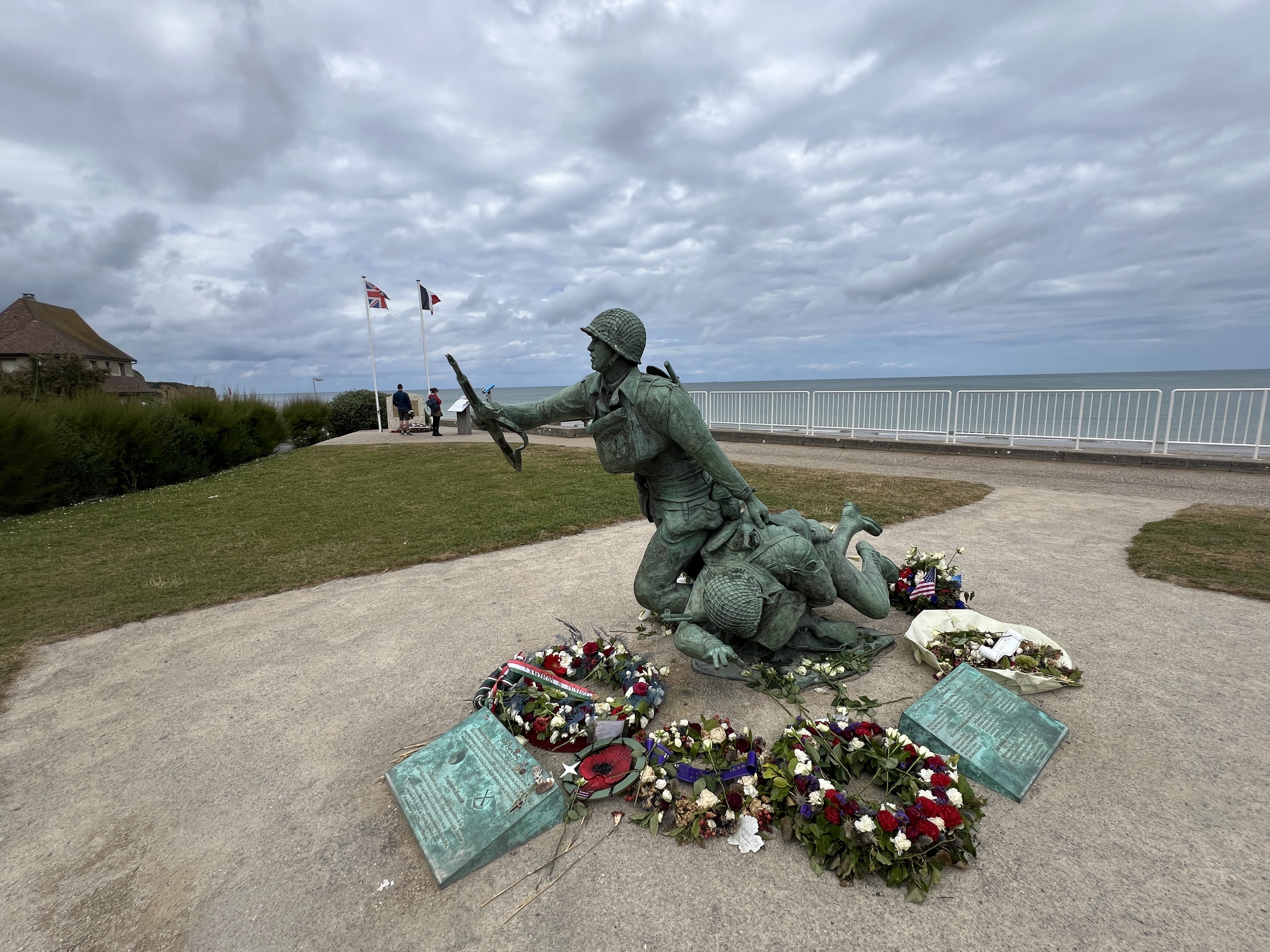
The year 2024 marked the 80th anniversary of D-Day, and we arrived just a week after commemorative ceremonies were held. Flower wreaths still rested where they were laid, now wilting, fading. What happened here then has been well documented in books, photographs, and movies. Today, parts of it look like any other beach. A place where children could run into the surf and build sandcastles, but thinking of their vulnerable bare feet and limbs so close to the ordinance and metal that still remains here gave me the chills. I’m glad to have experienced it — the enormity of it, the crushing weight of it. Whatever I write seems insignificant. So I’ll add photographs to the album, which don’t capture the experience but will have to suffice. 


Click here for our photos


Our campsite was on a high bluff overlooking the beach. In fact, right from our camper van, we could see the concrete “widerstandsnest” Germans used to shoot those on the beach far below. Our visit to the Normandy American Cemetery and Memorial touched us — again, words fail me, so photos will take their place.


Bayeux

A short ride away was the town of Bayeux, which was just unimportant enough at just the right time to escape destruction in WWII. The highlight of the town is the Bayeux Museum. Our RS guide describes it: “Essentially a 225-foot-long embroidered scroll stitched in 1067, the Bayeux Tapestry, known in French as the Tapisserie de la Reine Mathilde (Queen Matilda’s Tapestry), depicts, in 58 comic strip–type scenes, the epic story of William of Normandy’s conquest of England, narrating Will’s trials and victory over his cousin Harold, culminating in the Battle of Hastings on October 14, 1066.” So, needlepoint propaganda that gives incredible insights into how people lived. While here, we also visited the Cathedral Notre-Dame (of course) and the Musée Baron-Gérard, which included gorgeous porcelain and lace-making displays. The crêpes were delicious!


Honfleur

This old port town was a great place to wander. The ancient houses lean against each other, vying for space. The harbor lined with boats, colorful umbrellas, and tall buildings reflected so beautifully in the water are so picturesque that artists set up their easels, attempting to capture a fraction of its charm. 


After roaming far and wide, we indulged in some great meals here. One sunny day, we got a nice table by the harbor and enjoyed fresh seafood and some of the best people watching around. Our campsite had pétanque courts that were frequently in use with spirited games. The camp loaned us a set, and we tried our hand at it but the locals were unimpressed.


London

After dropping off our campervan in Bristol, we spent a few days in London, visiting family and taking in Hyde Park.


We had a great time in France visiting many new-to-us places.  Travel in France is always enchanting.


Upcoming 2025 trip: Spain, Portugal and Ireland. 

Monday, July 8, 2024

2024 France: Brittany

Pont Aven

As you read this we’ve been back at home for nearly two weeks. Posting was delayed primarily due to our much abbreviated schedule and a bit of illness. To compensate for the less contemporaneous descriptions, we’ve provided a large photo dump. Maybe that will even be preferable.  

Photos, lots and lots of photos

Brittany

A longish drive and over 50 euros in tolls brought us to this new region with its distinctive culture. It’s off the beaten path and that’s fine with us. The Celtic influences are still strong here and you’ll frequently see the Breton language - the only Celtic language still widely in use on the European mainland. According to Fodor’s it’s “France’s most fiercely and determinedly ethnic people, . . ..”  We visited quite a few small cities and towns never straying far from sea breezes. 


La Baule/Vannes

Our Bel Air campground was walking distance to the boardwalk high above the sandy beach with rocky outcroppings. Few braved the cool temperatures and moderate winds to bask seaside but a several sailboats plied the waters and many people strolled or jogged the boardwalk. From here we took a day trip to the walled town of Vannes which emerged from WWII undamaged. We found the port and half-timbered houses in various color schemes endearing in this inviting town. We had a delicious seafood meal at an unassuming restaurant about a block away from camp.


Carnac - The French Stonehenge

We had no idea such a place existed but it’s the largest site of standing stones of this type in the world. The megaliths here were erected during the Neolithic period (between 4500 and 3500 BC). Rows and rows of stones - over 3000, are aligned along this 4 kilometer site and it contains tumulus, dolmens and menhirs. The tumulus and dolmens are funerary edifices but the meaning behind the rows of menhirs hasn’t been determined. 


The current theory is that the space between the menhirs is important and it may be a sort of story being told. Since the sea level was much lower then, they know that many more stones are hidden under water. They may never unravel the secrets of this mysterious place.


Pont-Aven


Imagine a town so pretty that artists like Paul Gauguin flocked to the place trying to capture the idyllic scenes with canvas, oils and watercolors. The distinctive local garb, thatch-roofed houses, “Bois d’Amour,” picturesque mills and quaint harbor were irresistible. The Musée des Beaux-Arts houses locally-inspired pieces and we spent a nice afternoon there.      


Concarneau


Jutting into the harbor is the fortress-islet of Ville Close. The pictures don’t do just it justice because one view can’t set the scene of this medieval town enclosed within walls and surrounded by water. The entry is a drawbridge and the ramparts made for great climbing and views. So fun! 


Quimper


Half-timbered houses lean against each other along twisty streets in the old town. Two rivers run through the city and the bridges that link each side are lined with flower planters. The 15th century Cathédrale St.-Corentin has an impressive exterior and that’s flanked by a section of the original city wall. Further downstream is a Roman-era church and medieval garden which was a delight for all the senses.


Douarnenez


Searching the narrow, hilly streets for parking in the campervan was rough but once we found a space slightly less likely to result in damage we strolled into this old fishing town. The tourist map provided directions to quayside paths with great views that led up to “Ferme et gîtes des Plomac’h:” an old farm with small stone cottages typical of those in the 1700’s. A famous writer once resided here and the farm still has a small number of animals.


Trébeurmen

Our campsite was a steep walk down to a pinkish beach with rocky tidal pools surrounded by pink granite cliffs on either side. The sign gives a description of what sea creatures you can bring home for dinner. Our campsite even provided a special sink for washing them up.  


North of here we took a long hike called Senteniers des Douarnenez from Trestraou beach to St. Guirec beach and back around the oceanfront trail viewing fantastic pink granite rock formations that tumbled down to the ocean and small pink beaches that dotted the coast. Tidal pools supported periwinkles and other mollusks. A beer and cider break at Saint Guirec was just the ticket on this warm day.  


St. Malo

If the name seems familiar you’ve probably either read the book or watched the movie “All the Light We Cannot See.”  You know we love a good rampart and that’s about all we experienced on this rainy day. Well that, a medieval covered market and a quick stop at an Irish Pub. We happily followed the RS guide which explained the defensive walls. We caught glimpses of the far off Fort La Latte which was used for defense well into the 18th century. Though many city buildings look old, most were built after 1945. About 80% of St. Malo was destroyed in the final days of WWII. 


We covered alot of small towns from June 6 to 13!


Next Post: Normandy

Thursday, June 13, 2024

2024 France: The Southwest


Saint-Émilion

Toulouse

After a full 20 hours of assuring ourselves the van was fixed and it was safe to leave the area, we could finally begin our remaining, much shortened, available travel time. We landed in a camp outside Toulouse. Our camp host explained there were safe bike paths along a canal, mostly flat and it would only take about 40 minutes to make it into town. There was also a free and safe bike parking garage in the city center. Sold! Our experience differed greatly. It took us about 1 3/4 hours because we followed google maps (not always right) and our mini-bike wheels aren’t well-suited speed nor to the very rough and rocky parts. We also stopped for pedestrians and to relieve saddle-sore backsides. 


Ensemble Conventual des Jacobins


Click here for our photos, (i) for information.


Toulouse is nicknamed “La ville rose” (the pink city) because of its brick paved streets, rosy roofs, and red brick mansions. The “Capitol/Hotel de Ville” was closed for a wedding. We lingered at the medieval architectural wonder of the Ensemble Conventual des Jacobins. Its many arches formed a beautiful “palm” and interesting frescoes still grace its walls. 


Cathedral St-Étienne was built in stages from the 13th to the 17th centuries - apparently by people who had no appreciation for symmetry or balance. I’ve never seen the like. The fountain in front was the oldest in Toulouse.


The Basque Region


There are certain stereotypes of the French, but reality of France and its people is much more varied, richer, and deeper with distinct cultures fiercely held. The Basque language, or Euskara, is an isolate. It didn’t come from a more ancient language as did all other European languages. It’s Europe’s only currently spoken Paleo-language. Very few languages spoken today anywhere in the world can claim such. Imagine what combination of geography, culture and determination combined to enable a people to withstand the forces of assimilation to which most ancient languages have succumb. It’s fascinating to me. Directional and informational signs were provided in both languages which often left no room for English providing more of a challenge for us. There are many interesting aspects of basque culture and we only scratched the surface. The next four places are all in the Basque region.


Saint-Jean-de-Luz

Our campground was far outside the town on a bluff above the beach.  Though some sunbathed there, it was too cold for us. We thoroughly enjoyed our sea view and the sound of waves crashing into the rocky shoreline below from our campsite. The surrounding hedges offered just enough of a windbreak and privacy to stretch out our yoga mats on the grass and enjoy some yoga one sunny afternoon as we waited for our laundry to dry on the line. Several restaurants were within walking distance and also provided ocean views. A surprise find was a black pudding served with an apple compote that Dermot really liked.


The pretty fishing village of Saint-Jean-de-Luz became famous as the place French King Louis XIV married the Infanta Maria Theresa of Spain in 1660 to ensure peace between the two nations. It’s close to the border and about midway between Paris and Madrid. The Église St-Jean-Baptist where the wedding took place has a ceiling like a boat hull and raised galleries along the sides and back for the men. These galleries were in churches in other Basque villages as well.


We lucked into a Sunday fête complete with children and adults performing dances in regional costumes. Rather than staged for tourists, it felt like a true local event where parents and grandparents proudly clapped and congratulated the performers and later joined in the adult dances. Quite a few men sported berets which we hadn’t seen many of throughout the rest of France. In this region we even saw farmers working the fields in them as well.


We tried the recommended macarons made from the same recipe as those the King enjoyed centuries ago and they were delicious! Crisp on the outside and chewy on the inside. Of the regional foods on offer, we chose the “most basque” pâté and enjoyed it for its absolutely perfect amount of pepper and spice IMHO.


Beyond the port lies a wide, long beach and we took a relaxing stroll along the boardwalk following Rick Steves’ walk. I have to admit we perused the photos of ocean view properties in Sotheby’s.


The small Basque villages of Sare, Ainhou and Espelette were quick stops in the mountainous area briefly visited as we travelled to our next stop so I’ll lean on the photos to paint the picture. The circular gravestones here are basque. Each town has its own pelota court (a game very much like Jai Alai) with what looked like more than enough seating for the size of the village. At Sare we bought two “gâteaux basque” small cakes that are filled with either cherry filling or pastry cream - both were delicious.


St. Emilion

We skipped the city of Bordeaux in favor of this town set among miles of grapevines and enclosed with ramparts from its medieval past. Our campsite was like a resort surrounded by trees beside a lake and had multiple pools. One evening we paddled a kayak around the lake in the extended light hours searching for wildlife and recording bird calls. 


The campground was remote enough that buses did not run here, so the camp provided a shuttle service to and from the town. The town has an interesting history and grew over the years from low levels to those high above with steep streets linking the two. After exploring the interesting houses and historic abbey, we had lunch in a sun dappled square in the lowest level along with many other tourists. My salad had small slices of duck breast and enough duck gizzards to choke a wolf. 


The most unusual sight here was the monolithic cathedral which can only be visited on a guided tour. Inspired by the hermitage of St. Émilion (possibly a myth), limestone was excavated to create a partially subterranean church which is the largest monolithic church in Europe. The church was sold to a private citizen after the French Revolution and has been privately held since so we weren’t allowed to take pictures inside but there were multiple sections including a subterranean crypt.


We’re running behind on posts but we’ll get caught up eventually!


Paris Revisited

This leg of the trip is nerve racking. The big picture is that we need to put the campervan in storage in Bristol then fly from London to Sh...